Search This Blog

Showing posts with label 1948. Show all posts

Tuesday, July 28, 2009

Hannes Bok Illustrations, 1948


_____

L Sprague De Camp, author, Wheels of If Shasta. Hannes Bok, Illustrator. 1948, with brilliant dustjacket art by Hannes Bok (Wayne Woodard).

From wikipedia:

Wayne Woodard (the name is sometimes mistakenly rendered as "Woodward") was born in Kansas City, Missouri, the first stop in a peripatetic youth. His parents divorced when he was five; and his father and stepmother, strict disciplinarians, discouraged his artistic efforts. Once he graduated high school, in Duluth, Minnesota, Bok cut off contact with his father and moved to Seattle to live with his mother. There he became active in SF fandom, including the publication and illustration of fanzines. It was in connection with these activities that he originated his pseudonym, first "Hans", then "Hannes", Bok. The pseudonym derives from Johann Sebastian Bach (whose name can be rendered both as "Johann S. Bach" and "Johannes Bach").

Saturday, July 18, 2009

Stapledon to Moskowitz

Stapledon, William Olaf. AUTOGRAPH LETTER SIGNED (ALS). 1 page, dated 30 March 1948, to "Dear Mr. [Sam] Moskowitz," signed "Olaf Stapledon," written on Waldorf-Astoria stationery. Declines an invitation to "the meeting and to dinner on Sunday next. Since arriving in this country, I have been desperately rushed, and indeed have not had a spare half hour to deal with my correspondence. It would have pleased me very much to accept, but unfortunately I have to be in Boston on that evening, to lecture, and must regretfully refuse ... I feel that my negligence is inexcusable, but really I have had an extremely busy few days, and am wondering whether I can survive the wild rush of American life until I leave for England by plane on Monday!" Stapledon spent eleven days in the U.S. where he participated in the Cultural and Scientific Congress for World Peace. "As the sole Western European admitted to the conference, he was not only in constant demand for interviews but had been asked to help open the proceedings with a speech at a black-tie dinner in the Waldorf's grand ballroom. A packed itinerary left him little time to take in what was happening, but the luxury of his surroundings amused and disgusted him. The hotel was 'full of extravagantly wealthy people,' Olaf told Agnes, and a microcosm of the whole 'air-conditioned civilization' of America" (Crossley, p. 371). For an account of Stapledon's visit to America, see Crossley. Olaf Stapledon: Speaking for the Future (1994), pp. 369-81. Faint mailing folds, else fine. Accompanied by the mailing envelope. (#96354)

Sunday, August 24, 2008

FANTASY ADVERTISER-3/1948 PULP FANZINE


FANTASY ADVERTISER-3/1948-PULP FANZINE

Thursday, August 21, 2008

Wednesday, August 20, 2008

Friday, August 15, 2008

Fantasy Review Vol II No 8 April-May 1948


Fantasy Review Vol II No 8 April-May 1948

Future Fiction O.K. Now : Heinlein No Model — Critic
From Forest J. Ackerman

The recent tendency towards science fiction in the slicks such as Robert Heinlein’s spece-travel stories in Satevepost may only be a flash in the pan. Although the general magazines are now prepared to entertain tales with futuristic settings the accent must still be on the story rather than the setting. In this respect, the editorial attitude hasn't changed according to Peter Granger who devoted his Review Page in the March Writer's Market and Methods to "Unusual Fiction".
Says Granger: The World of Tomorrow seems at last close enough, or at least predictable enough, to be acceptable in most magazines as the stage for characters to be on. This is that rather limited formula future which is no further from today than transatlantic airways were in the 1920's, and certainly not so far away as was the atom bomb in ‘40. The writer interested in the field for general magazine submissions must be content. with the non-prophetic story it seems, and must keep in mind that editorial eyes are hardly further ahead of fact than is the newsreel. This tends to bring the story close to to-day...”

Mentioning Heinlein's recent Post story, “The Black Pits of Luna he maintains that, for the writer interested in this form of fiction. It "should serve as a warning rather than an example or model to be followed. The author has depended so much upon the novelty of the setting, the strangeness of the locale, to hold the reader that he has worked no tangible story, bet has used an incident to keep his characters moving against his scenery. It would seem that this story would represent the extreme limits to which an author could go without a a story and still make a sale. A writer trying this field would be on firmer ground giving considerably more attention in story value and characters of some interest to the render".

At the same time Granger recommends writers of the more everyday story to study fantasy-fiction for the methods it employs to induce plausibility. "Characterisation usually must be very strong to keep the reader feeling there is a human connection between himself and the story. Plot details are usually clear-cut and definite, with the relation of the actions and results to the characters very distinct," he admits.

Thursday, August 14, 2008

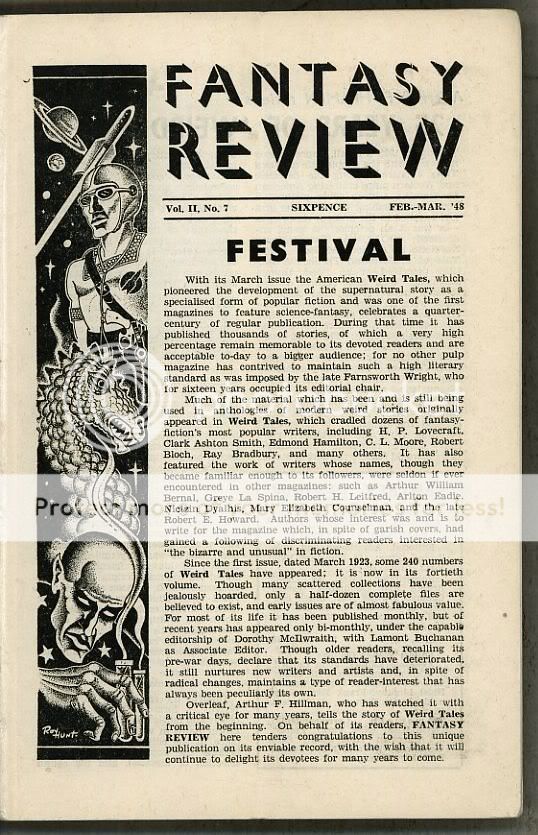
Fantasy Review Vol II No 7 February-March 1948


Fantasy Review Vol II No 7 February-March 1948

With its March issue the American Weird Tales, which pioneered the development of the supernatural story as a specialized form of popular fiction and was one of the first magazines to feature science-fantasy. celebrates a quarter century of regular publication. During that time it has published thousands of stories, of which a very high percentage remain memorable to its devoted readers and are acceptable today to a bigger audience: for no other pulp magazine has contrived to maintain such a high literary standard as was imposed by the late Farnsworth Wright. who for sixteen years occupied its editorial chair.
Much of the material which has been and is still being used in anthologies of modern weird stories originally appeared hi Weird Tales, which cradled dozens of fantasy fiction’s most popular writers. including H. P. Lovecraft, Clark Ashton Smith, Edmond Hamilton, C. L.. Moore, Robert Bloch, Ray Bradbury, and many others, It has also featured the work of writers whose names, though they became familiar enough to its followers, were seldom if ever encountered in other magazines: such as Arthur William Bernal. Greye La Spina, Robert H. Leitfred, Ariton Eadle. Nietzin Dyalhla, Mary Elizabeth Counselman, and the late Robert E. Howard. Authors whose interest was and is to write for the magazine which, in spite of garish covers, had gained a following of discriminating readers interested in "the bizarre and unusual" in fiction.
Since the first issue, dated March 1923, some 240 numbers of Weird Tales have appeared; It is now in its fortieth volume. Though many scattered collections have been jealously hoarded, only a half-dozen complete files are believed to exist, and early issues are of almost fabulous value. For most of its life it has been published monthly, but of recent years has appeared only bi-monthly under the capable editorship of Dorothy McIlwraith, with Lamont Buchanan as Associate Editor. Though older renders, recalling its pre-war days, declare that. its standards have deteriorated. It still nurtures new writers and artists and. In spite of radical changes, maintains a type of render-Interest that has always been peculiarly its own.
Overleaf, Arthur F, Hillman, who has watched it with a critical eye for many years, tells the story of Weird Tales from the beginning. On behalf of its readers. FANTASY REVIEW here tenders congratulations to this unique publication on its enviable record, with the wish that it will continue to delight its devotees for many years to come.

Thursday, August 7, 2008

Fantasy Times # 71 (1948)

The only details are that this 'zine is from Fandom House 1948
12 pages cover John Giunta
with essays on
Xerography - Ray Van Houten
Fantasy In Radio And TV
Book Notes

John Giunta (1920-1970) was an artist that focused on the fantastic.
He's listed in his early career:
Art Director: 1939 Scienti-Tales [fanzine]
BERNARD BAILY STUDIO (pen/ink/) 1944
CHESLER STUDIO (let/col/) 1938-39
FUNNIES INC. (pen/ink/) c1941-c45
BAILY PUBLICATIONS
CISCO KID, THE (pen/ink/) 1944
Covers (pen/ink/) 1944-45
FUNNYMAN (pen/ink/) 1944 (A Shuster and Siegel item}
HURRY KANE (pen/ink/) c1945 unconfirmed
MR. LUCIFER (pen/some ink/) 1945-46
CENTAUR COMICS
MAGICIAN FROM MARS (pen/ink/) 1939-40
Text (wr/) c1939 about fanzines
SNOWMAN (pen/) 1944

Sunday, July 27, 2008

Obscure Fanzine (1948-1949) with Keller, Bloch, Hoffman Price, and others

Here are some interesting vintage fanzines that show how the "names" really did what they could to support the local and regional fan magazines. They'd send letters, write short articles, pose for pictures, and anything else they could do to help with the circulation of these fanzines.


NUMBER 7, Vol. 2 No. 1 (February 1949)
Fiction – The Sea—Rex (by Evan H. APPELMAN), Library Notes (by Joe SCHAUMBURGER); Articles – Fantasy Collecting (by S. A. PEEBLES), Fantasy on Record (by R. H. RAMSAY), U-N-A-E-C—Will It Work? (by C. Lee RIDDLE); Letters from: Len MOFFATT, E. Hoffmann PRICE, Jim HARMON, et al.; Ski Duty (cartoon by Ed HUGHES). Cover by Jack R. WAIDA. * VERY GOOD-, back detached (but present). 22 pages. Addressed on back to: Robert F. (Flavie) CARSON (Rich Hill, MO.).

NUMBER 8, Vol. 2 No. 2 (May 1949 – Anniversary Issue)
The Key (by John A. KEEL), The Fallacy of Mass Rule (by Vaughn GREENE), Dear Editor (by C. Lee RIDDLE), The Experiment That Failed (by Edward W. LUDWIG), Why We Lost the Battle of Tel-Amen (by Donn BRAZIER), Library Notes (book review, by David H. KELLER), Lament for a Lost Love (verse, by Robert BLOCH), The First Modern Horror Novel (by Anthony BOUCHER), The Sacrifice (by Jack CORDES), A Suggestion (by Jack RIGGS). * GOOD+/VG-, old water staining at top corners. 32 pages. “R. Flavie Carson” penned inside front cover.

_____


VOLUME 1 NUMBER 3 (October 1948)
Fiction – Identity (by Wally WEBBER); Poetry – North Plains Tale (by R. Flavie CARSON), The Thing in the Swamp (Jack CORDES), A Fan (by Franklin M. DIETZ, JR.), The Return of Nature (by David H. KELLER, M.D.); Articles – Let’s Graph It (by the editor), Frankenstein: 1817-1948 (by Claude PLUM). Cover by John GROSSMAN. * GOOD, old water staining to top corners and bottom edge, front detached at top staple, back detached (but present). 22 pages. Addressed on back to: Robert F. (Flavie) CARSON (Rich Hill, MO.). Pages 19 and 20 of PEON #2, LAID IN.

NUMBER 6 (January 1949)
Going Home (by D. MASON); The Happy Physicist To His Nymph and Ode Upon the NEW YORKER’s Discovery of Science Fiction (forced upon us by D. and V. MASON); Fantasy Collecting (by S. A. PEEPLES); The Green Letter (response by Thomas M. SAWRIE); Happy (?) New Year! (cartoon by Ed HUGHES). * GOOD+, old water staining to top corner, light soiling, double-hole punch throughout. 8 pages. Addressed on back to: Robert F. (Flavie) CARSON (Rich Hill, MO.).

Navigation

You're at "Chrispy's Antiquarian Horror Page".
_____

Go Back to Original HPL blog
_____

_____