Search This Blog

Friday, August 15, 2008

Fantasy Review Vol II No 8 April-May 1948


Fantasy Review Vol II No 8 April-May 1948

Future Fiction O.K. Now : Heinlein No Model — Critic
From Forest J. Ackerman

The recent tendency towards science fiction in the slicks such as Robert Heinlein’s spece-travel stories in Satevepost may only be a flash in the pan. Although the general magazines are now prepared to entertain tales with futuristic settings the accent must still be on the story rather than the setting. In this respect, the editorial attitude hasn't changed according to Peter Granger who devoted his Review Page in the March Writer's Market and Methods to "Unusual Fiction".
Says Granger: The World of Tomorrow seems at last close enough, or at least predictable enough, to be acceptable in most magazines as the stage for characters to be on. This is that rather limited formula future which is no further from today than transatlantic airways were in the 1920's, and certainly not so far away as was the atom bomb in ‘40. The writer interested in the field for general magazine submissions must be content. with the non-prophetic story it seems, and must keep in mind that editorial eyes are hardly further ahead of fact than is the newsreel. This tends to bring the story close to to-day...”

Mentioning Heinlein's recent Post story, “The Black Pits of Luna he maintains that, for the writer interested in this form of fiction. It "should serve as a warning rather than an example or model to be followed. The author has depended so much upon the novelty of the setting, the strangeness of the locale, to hold the reader that he has worked no tangible story, bet has used an incident to keep his characters moving against his scenery. It would seem that this story would represent the extreme limits to which an author could go without a a story and still make a sale. A writer trying this field would be on firmer ground giving considerably more attention in story value and characters of some interest to the render".

At the same time Granger recommends writers of the more everyday story to study fantasy-fiction for the methods it employs to induce plausibility. "Characterisation usually must be very strong to keep the reader feeling there is a human connection between himself and the story. Plot details are usually clear-cut and definite, with the relation of the actions and results to the characters very distinct," he admits.

Thursday, August 14, 2008

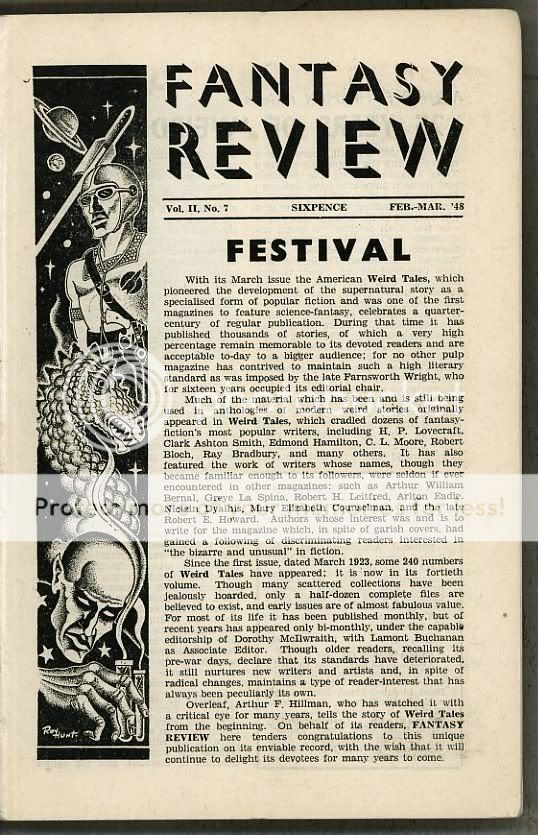
Fantasy Review Vol II No 7 February-March 1948


Fantasy Review Vol II No 7 February-March 1948

With its March issue the American Weird Tales, which pioneered the development of the supernatural story as a specialized form of popular fiction and was one of the first magazines to feature science-fantasy. celebrates a quarter century of regular publication. During that time it has published thousands of stories, of which a very high percentage remain memorable to its devoted readers and are acceptable today to a bigger audience: for no other pulp magazine has contrived to maintain such a high literary standard as was imposed by the late Farnsworth Wright. who for sixteen years occupied its editorial chair.
Much of the material which has been and is still being used in anthologies of modern weird stories originally appeared hi Weird Tales, which cradled dozens of fantasy fiction’s most popular writers. including H. P. Lovecraft, Clark Ashton Smith, Edmond Hamilton, C. L.. Moore, Robert Bloch, Ray Bradbury, and many others, It has also featured the work of writers whose names, though they became familiar enough to its followers, were seldom if ever encountered in other magazines: such as Arthur William Bernal. Greye La Spina, Robert H. Leitfred, Ariton Eadle. Nietzin Dyalhla, Mary Elizabeth Counselman, and the late Robert E. Howard. Authors whose interest was and is to write for the magazine which, in spite of garish covers, had gained a following of discriminating readers interested in "the bizarre and unusual" in fiction.
Since the first issue, dated March 1923, some 240 numbers of Weird Tales have appeared; It is now in its fortieth volume. Though many scattered collections have been jealously hoarded, only a half-dozen complete files are believed to exist, and early issues are of almost fabulous value. For most of its life it has been published monthly, but of recent years has appeared only bi-monthly under the capable editorship of Dorothy McIlwraith, with Lamont Buchanan as Associate Editor. Though older renders, recalling its pre-war days, declare that. its standards have deteriorated. It still nurtures new writers and artists and. In spite of radical changes, maintains a type of render-Interest that has always been peculiarly its own.
Overleaf, Arthur F, Hillman, who has watched it with a critical eye for many years, tells the story of Weird Tales from the beginning. On behalf of its readers. FANTASY REVIEW here tenders congratulations to this unique publication on its enviable record, with the wish that it will continue to delight its devotees for many years to come.

Wednesday, August 13, 2008

Fantasy Review Vol.1 No. 6 Dec 1947 – Jan 1948


Fantasy Review Vol.1 No. 6 Dec '47 – Jan '48

Reviver

With this issue of Fantasy Review completes a year of publication within its new lease on life. During that time it has gained a staunch following of readers which is still growing and extending to many parts of the world. There is evidence that all have found it of inestimable value in their pursuance of fantasy-fiction as an abiding interest, or as one which some had neglected for lack of a reliable source of information and guidance in the field. To others it has made apparent for the first time the full extent of the medium and aroused in them an enthusiasm which has been reflected in their letters.

Fantasy Review is, manifestly, fulfilling a unique service, not only to its devotees but to fantasy-fiction itself. Through all its critical articles and reviews it is performing a desirable function in maintaining and improving the standards of the literature it covers. By providing a contact between writers, editors, publishers and readers it is assisting all concerned towards a better appreciation of their activities and their varying points of view. As a means whereby all may ventilate their opinions, it has already proved itself an essential to the healthy development of the medium on both sides of the Atlantic.

For the future, Fantasy Review has many plans for the further expansion of the interests it fosters and caters for as adequately as it can in these days of austerity. As we proceed we shall introduce new features whenever space allows and continue to present the best available articles to interest our widening circle of readers. Our book reviews, which have brought countless expressions of appreciation for their discerning and informative character, will always be an important feature of each issue. In the series of interviews with famous fantasy writers, we have many interesting personalities to present, including Dr. Edward E. Smith, creator of the popular "Lensman" stories.

If a subscription blank is enclosed, it means that your subscription has expired with this issue. You would be well advised to renew it without delay, before you run the risk of missing our next or subsequent issues – and please note the new address to which all communications should be sent. We look forward to hearing from any of our readers who have not yet sent us their suggestions or criticisms, and to the letters we invite from all for the new feature we have introduced in this issue. - Fantasy Forum.

Tuesday, August 12, 2008

Fantasy Review Vol. 1, No. 5 Oct-Nov 1946


Fantasy Review Vol. 1, No. 5 Oct-Nov 1946

Reverse by Wallter Gillings

The paper shortage has forced the suspension of Fantasy – the Magazine of Science Fiction, after only three issues. It is not expected that it will be able to resume publication for at least two years.

It is no less than 17 years since, impressed with the growing interest in the American science fiction magazines entering this country {UK}, I began to draw the attention of British publishers to the possibilities of this field. That was in days when an English magazine so specialized in its appeal was a rare thing, and the numbers of readers keen enough to seek out "remainders" of Amazing and Wonder Stoires at htreepence a copy were comparatively small. Looking back now, I can see that the publishers I pestered were probably right in their contention that it was not enough to make a British magazine a profitable proposition: though I never would accept the objection that, anyway, Verne and Wells had done it all before.

However, one very reputable firm did issue a twopenny weekly which sought to emulate the Gernsback touch and, when it transpired that all its readers were not errand boys, tried to make itself more respectable, only to fall dismally and wind up altogether. After that another big publishing house, affected by the trend towards specialization in fiction, seriously considered the project of a shilling magazine which would interest the enlarging fraternity of science fiction readers and appeal to a wider public at the same time. This project occupied them, and the few British writers competent to meet its literary requirements for over a year before it was decided to abandon the idea.

Then, as a result of y importunings elsewhere, came Tales of Wonder, whose first trial issue was followed in due time y its regular quarterly publication – and, in turn, by revival of the project which brought forth three issues of Newnes' Fantasy. Then, inconsiderately, came World War II. Only Tales of Wonder struggled on, until after 16 issues the beginnings of the paper shortage forced its suspension.

In between times the American "remainders" (always a thorn in the flesh to British publishers) had given place to home-produced editions of Astounding and Unknown which, fortunately, are still with us. And when, before the war was over, more impressed that ever with the prospects … {All the text available}.

Monday, August 11, 2008

Fantasy Review Vol. 1 No 3 Jun-Jul 1947


Fantasy Review Vol. 1 No 3 Jun-Jul 1947

Walter Gillings' Fantasia

Noted American science fictionist Theodore Sturgeon carried off L250 prize offered by English Argosy is hort story contest. Winning piece, presented "with pride" in May issue, praised for its "strange imaginative quality," was "Bianca's Hands," reputedly spurned by several U.S. mags, including Unknown Worlds, in which Sturgeon started. British fantasy authors who entered contest feeling slightly piqued … "Homecoming." Story by Ray Bradbury originally in Street & Smith's Mademoiselle, selected for O. Henry Memorial Award, to be reprinted in Avon Fantasy Reader. His fantastic, "The Meadow" also won prize in radioscript contest. Collection of his weird tales, "Dark Carnival," forthcoming from Arkham House. … Recipient of Atlantic Award to encourage novel writers is C. S. Youd, editor New Frontiers, now suspended.

Television versions of "Mr. Mergenthwirker's Lobbies," much-radioed fantasy by Nelson S. Bond (see book reviews, last issue), presented recently from London. … Following death at 81 of M. P. Shiel, appreciation of his work, with special reference to "The Purple Cloud," given on Third Programme … H. P. Heard, author of "Doppelgangers" (reviewed this issue) and "The Great Fog and Other Weird Tales." Is – or was – famous British science writer Gerald Heard, now living in Hollywood …

Another Mag. Coming

New magazine to carry original s-f, fantasy, weird and ghost story material, with Donald Wolheim editing, being planned by Avon Publications, New York, producers of Fantasy Reader. First issue due before year's end … Leo Marguiles, Thrilling Wonder's editorial director, writing in American Writer on science fiction field, warned would-be specialists its readers were "most articulate group in the world." … Max J. Hertzberg, prominent U.S. educator, literary editor Newark Evening News, encourages reading of s-f among pupils … Saturday Review of Literature featured article by L. Sprague de Camp, "The Unwritten Classics," dealing with fictitious books invented by fantasy writers, e.g. Lovecraft's "Necronomicon" … Earlier issue carried letters from P. Schuyler Miller Frederick B. Shroyer, on current s-f book boom and efforts to compile bibliography of fantasy, now proceeding in various directions … /

Navigation

You're at "Chrispy's Antiquarian Horror Page".
_____

Go Back to Original HPL blog
_____

_____